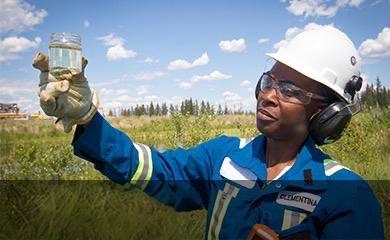
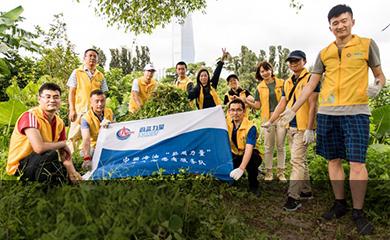
CNOOC Limited attaches great importance to emissions management and consistently adheres to environmental protection management throughout the entire project lifecycle. The Company strengthens the combination of source prevention, process control, and end-of-pipe treatment, strictly complying with the laws, regulations, and policy documents of the countries and regions where it operates. We have formulated institutional frameworks including the Management Rules for Ecological Protection and Pollution Prevention and Control and Management Rules for Discharge Permit and Environmental Protection Information Technology. The Company rigorously implements the requirements of standards and specifications including the Effluent Limitations for Pollutants from Offshore Petroleum Exploration and Production (GB 4914-2008), the Biological Toxicity for Pollutants from Marine Petroleum Exploration and Exploitation (GB 18420.1-2009), the Discharge Standard for Water Pollutants from Ships (GB 3552-2018), the Integrated Emission Standard of Air Pollutants (GB 16297-1996), the Emission Standard of Air Pollutants for Onshore Petroleum and Gas Extraction and Production Industry (GB 39728-2020), the Technical Specification for the Collection, Storage and Transportation of Hazardous Waste (HJ 2025-2012), and the Standard for Pollution Control on Hazardous Waste Storage (GB 18597-2023). The Company comprehensively manages all emissions generated during operations, including wastewater, exhaust gases, solid waste, and noise.
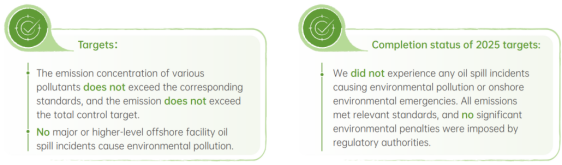
All types of wastewater, waste gas, and solid waste discharges from CNOOC Limited meet national and local standards, which has not caused adverse effects to employees or local community residents. During the reporting period, the Company did not experience any major or higher-level offshore facility oil spill incidents causing environmental pollution. There were no instances of significant administrative penalties or criminal prosecution due to the discharge of water pollutants, air pollutants, or solid waste. The monitoring plans and risk management measures for various types of pollutants operated effectively, with no material weaknesses.
Wastewater
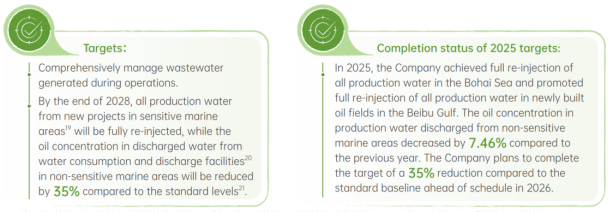
In 2025, CNOOC Limited employed scientific management measures and advanced process technologies. For strictly treated wastewater, the Company adopted scientifically sound disposal measures including compliant discharge, formation re-injection, or reuse. These measures effectively prevent and control potential pollution risks to marine and terrestrial ecological environments from wastewater.
The Company implements differentiated treatment for wastewater in different sea areas. In the Bohai Sea, all oily production water is re-injected after multi-stage treatment, with an annual reinjection volume exceeding 240 million cubic meters, achieving "zero discharge." In the Beibu Gulf, the Company strictly restricts new discharges and relies on the water injection capacity of newly built platforms to achieve the goal of increasing production without increasing pollution. In other non-sensitive marine areas, measures such as downhole water control and oil stabilization, optimization of treatment chemicals, and upgrading of treatment equipment have been adopted to reduce production water emissions and decrease oil concentration. CUCBM utilizes water produced from onshore unconventional gas fields to prepare fracturing fluid, significantly increasing the reuse rate and initially forming a virtuous cycle of emission reduction and efficiency enhancement.
Waste Gas
CNOOC Limited strictly complies with environmental regulations and policies in countries and regions where it operates. It actively addresses associated gas treatment in oil fields by improving the recovery and utilization rate of associated gas through technological improvement, and disposing of the small amount of associated gas that can't be utilized by flaring or reinjection in accordance with the environmental standards. In 2025, the Company employed methods including condensate oil storage tank floating roof retrofitting and upgrading, high-concentration oil and gas recovery from onshore terminals into the natural gas system, and low-concentration waste gas adsorption treatment from wastewater systems. The Company actively implemented the deployment requirements of competent government authorities on air quality assurance work, conducted special inspections on air pollution prevention and control, and vigorously promoted volatile organic compounds (VOCs) emission reduction at onshore terminals, playing an important role in the coordinated advancement of energy development and environmental protection.

Solid Waste
In 2025, CNOOC Limited focused on strengthening the data traceability system for the transfer of general (non-hazardous) waste and hazardous waste. The Company successfully launched a full-process solid waste management system, comprehensively covering key management elements including waste-generating units, personnel, marine vessels, land transportation units, and disposal units. This system ensured a seamless digital integration of solid waste management, spanning planning, process tracking, and end-point supervision. It marks a significant step in advancing our transition to intelligent, digital solid waste management.
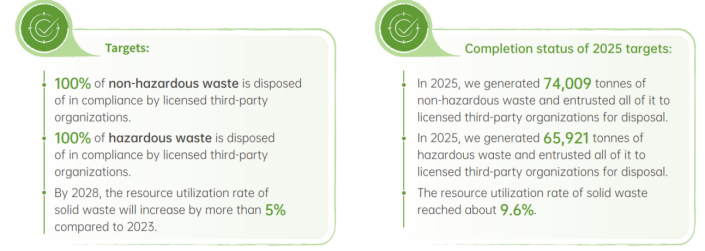
The Company attaches great importance on capacity building in waste and pollutant management for employees. Through a model combining online learning platforms with on-site practical operations, the Company regularly provides employees with systematic waste and pollutant management training. Training content covers environmental protection laws and regulations, pollutant treatment technologies, key points of environmental protection management, and other professional knowledge.
In 2025, the Company conducted a total of 4 online and offline training sessions, with 1,324 person-time and a total training duration of 66,866 hours.